

Everyone has limited time and wants more money. Ideally, you should aim to generate more revenue without your account executives needing to work more, and that’s where the Setter-Closer Model comes in.
To help you understand how to implement this model effectively, we'll explain the various commission structures companies typically use and the specific skills required for each role.
Outline:
- What is the Setter-Closer Model?
- Who makes a good setter?
- How exactly does the Setter-Closer Model operate?
- Frequently Asked Questions about the Setter-Closer Model
- Conclusion
What is the Setter-Closer Model?
The Setter-Closer Model is when one rep focuses solely on scheduling appointments (setter), the other (closer), follows up on those appointments to finalize the sale.
This model operates on the principle that humans are easily distracted.
It takes 23 minutes and 15 seconds to return to an original task after an interruption, according to Gloria Mark, who studies digital distraction at the University of California, Irvine.
The Setter-Closer Model maximizes the way the human brain works by separating prospecting from what is usually one job function into two: the “setter” and the “closer”.
This separation allows one person to focus on finding prospects and another person to focus on meeting with the prospects and closing deals.
In many cases, the setter-closer relationship can sometimes be similar to a mentee-mentor partnership, where the pair work in a positive feedback loop.
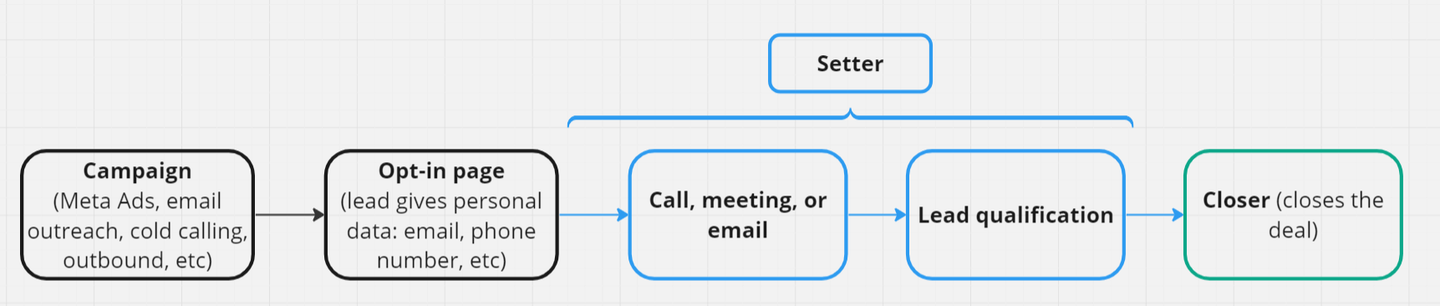
Who makes a good setter?
While it may be assumed that the setter should be someone junior, this is not necessarily true. What’s more important is that the setter is open to learning and being coached by the closer on what businesses to be on the lookout for (and it’s a plus if they are tech savvy).
Also, framing the role of the setter to be a position with great career growth is imperative in our rapidly changing world.
We always encourage businesses to take the time to teach setters as much as possible and have them listen in on calls that the closers have with potential tenants. Taking this approach builds company culture and just might mean training your next Head of Sales!
Here’s a list of some titles that typically make good setters.
- Admin
- Executive Assistant
- Virtual Assistant
- Junior Agent/Broker
- Intern
- Leasing Coordinator
- Marketing Coordinator (& Marketing in general)
How exactly does the Setter-Closer Model operate?
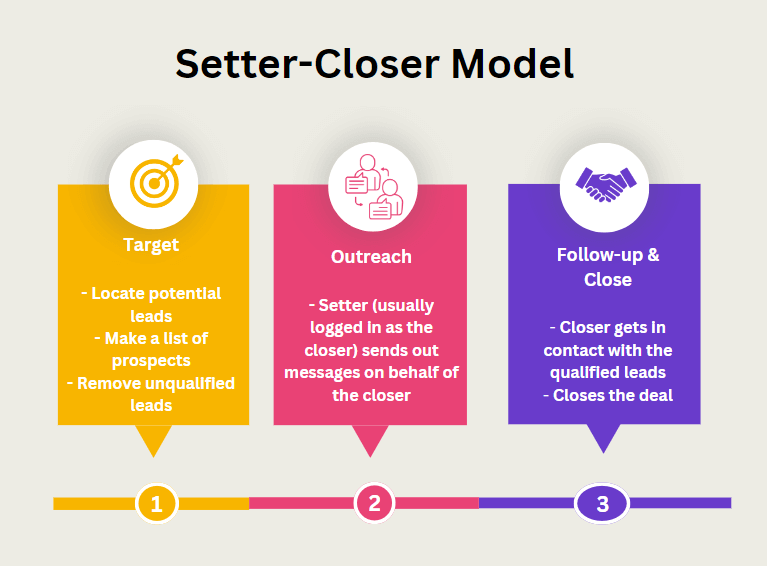
The graphic above displays how the model functions. For the first step, the setter takes the time to locate the potential leadsthat could be a good fit for your product or service.
Next, the setter (usually) logs in as the closer to reach out to the list of potential prospects. This can be done through email, Facebook message, Instagram DM, or phone call (sometimes a combination of these).
Lastly, the setter stays in close communication with the closer and lets them know who responded to the initial outreach or who is scheduled for a demo in their calendar.
Once this happens, it’s the closer's job to reach out to the prospect as soon as possible to see if a potential deal could be reached.
The closer makes sure to take the time to coach the setter on which leads are qualified, helping to create the positive feedback loop we mentioned earlier.
And most importantly – don’t forget how important it is to follow-up. It often takes more than 8 touchpoints to close a deal.
Frequently Asked Questions about the Setter-Closer Model
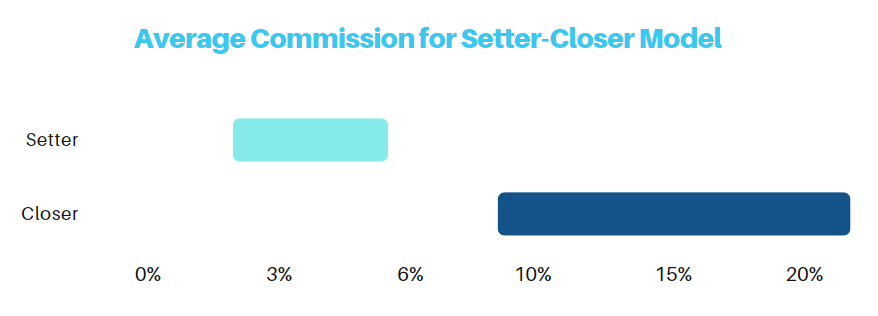
What is the typical commission?
The typical commission ranges from 3% to 5% for a setter and from 10% to 20% for a closer. These averages can vary depending on your industry, deal size, and other factors.
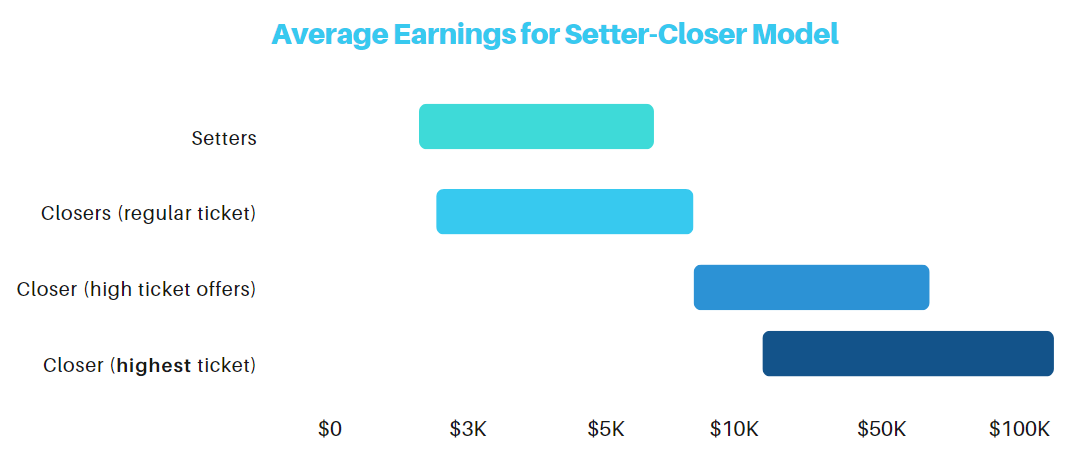
What are the potential earnings in the Setter-Closer Model?
The industry standards for average earnings for a setter range from $3K to $10K per month.
For example, if a setter sends 20 qualified leads weekly to a closer, and the closer converts 30% of those leads into customers, an average of 6 deals are closed weekly. This results in 24 deals being closed monthly.
If each deal has a ticket size of $7,500, a 3% commission for the setter amounts to $225 per deal.
Multiplying $225 by 24 deals results in $5,400 in commission per month.
Now let’s consider a scenario where the setter improves his KPIs (Key Performance Indicators) and is now sending 50 qualified leads weekly, resulting in 15 closed deals per week, or 60 deals monthly.
60 deals x 3% commission ($225 per deal) = $13,500 in monthly commission.
Regarding the average earnings for the closer, the industry standard for the lowest ticket deals ranges from $3K to $10K.
With higher ticket offers, this can increase to $10K to $50K. The highest ticket deals can reach up to $30K to $100K monthly.
What are the main skills a setter and a closer should have?
Since the setter is the initial contact for the client and is responsible for making a strong first impression, they need excellent communication skills and a thorough understanding of the product or service they are offering.
The closer needs to possess extensive knowledge about the product or service and be able to address any questions or objections from the client.
As skilled negotiators, they work to overcome objections and address concerns or doubts. The closer needs to be both persuasive and persistent while maintaining a positive relationship with the client.
Conclusion
The Setter-Closer Model is a great option for companies that need a large volume of leads coming in weekly and want the closer to focus only on qualified leads. This model is typically used for medium to high-ticket sales.
The setter focuses on generating leads and scheduling appointments, whereas the closer focuses on convincing the client to make a purchase.
The setter must have strong communication abilities and product knowledge, while the closer must excel in negotiation and have a deep understanding of the client's needs and concerns.
If you enjoyed this blog post, subscribe to our newsletter to receive weekly tips about selling to local businesses.

How to Fix Low Reply Rates in Local Business Email
Low reply rates in local business email outreach usually trace back to targeting, volume, messaging, deliverability, or follow-up. Here are seven things to check before you rewrite another cold email.
 Marcelo Dias·August 10, 2026·10 min read
How to Reach Local Business Decision Makers in CRE
A commercial real estate email outreach playbook to reach local business decision makers, fill vacant space, and run CRE prospecting that actually replies.
 Haroldo Uemura Tápias·July 29, 2026·8 min read
How to Improve CRE Email Outreach in 2026
Generic sales tools weren't built for leasing. Here's how CRE teams reach local business decision makers with personalized, deliverable email, and how to choose outreach tools made for tenant prospecting.
 Erik Camara·July 2, 2026·10 min read
Local businesses in your pipeline, made easy.
14M+ verified businesses for you to reach out to. AI-personalized messages that sound human-made. All running in 5 minutes.